
Bloodroot
Sanguinaria canadensis
You'll find the plant poking up through leaf litter on shady woodland hillsides. It's common name is derived from its blood-red roots. Bloodroot has ephemeral white flowers that are among the first blooms in the late winter/early spring. Bloodroot's brilliant blooming period only lasts a few weeks and the flowers close at night and on cloudy days.

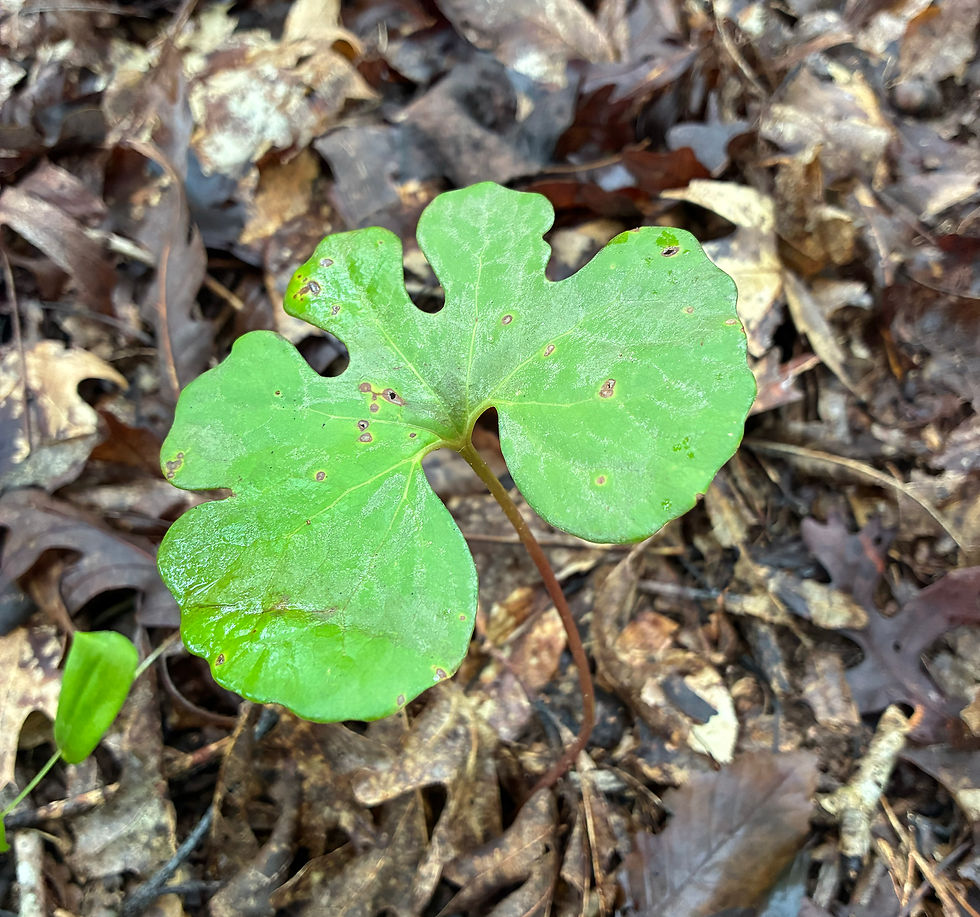
Identification
-
Most plants have 5-9 deeply scalloped lobes.
-
Flowers are white with 8-16 petals and a yellow center.
-
Grows 6-15 inches tall with leaves reaching 9 inches across.
Also Known As: Red Puccoon, Indian Paint, Bloodwort
Life cycle
Flowers bloom in the spring and the seed-pod fruits develop April - May. The foliage dies before the first frost in fall and grows back in the spring.
Fun Fact: Aided by ants
Bloodroot relies on ants to disperse its seeds. Ants will carry the seeds to their nests to eat the elaiosome, a fatty protrusion that resembles a grub. After this, they will leave the seed, therefore providing it with an ideal place to sprout. Unfortunately, invasive ants such as fire ants are disrupting this process, as they often damage the seed or don’t leave them in places that are conducive to germination.
WARNING
Bloodroot is poisonous to humans and animals in high dosage. Please leave bloodroot undisturbed.
Partridgeberry
Mitchella repens
A woody, evergreen vine, partridgeberry is often found creeping over rotting logs or carpeting shaded forest floors.
Identification
-
Grows 2-3 inches tall and spreads 12 inches wide
-
Glossy, oval-shaped leaves grow in pairs opposite each other.
-
Small white flowers with 4 to 5 petals are shaped like starfish.
-
Flowers bloom in pairs, giving them nickname “twin berry.”
-
A single red berry grows per each pair of flowers.


Life cycle
As an evergreen perennial, it retains its leaves throughout the cold months. Small white flowers bloom in spring, while the berries are ripe during late summer (June to July) and may persist through the winter.
Also Known As: Twinberry
Fun Fact: food for the feathered and furry
Its fruits are eaten by songbirds, ruffed grouse, wild turkeys, quail, and small mammals.
Striped Wintergreen
Chimaphila maculata
A small evergreen wildflower, striped wintergreen is truly striking in the winter when it is one of the only green plants populating the forest floor.
Identification
-
Leaves 1-3 inches long. They are dark green and mottled with a distinctive light stripe through the middle.
-
The leaves are leathery to the touch with sharp-toothed margins.
-
A small pink/white flower or cluster of flowers appear on top of a pinkish, 8-inch central stalk in the summer.

Also Known As: Spotted Wintergreen, Rat's Bane, Striped Prince's Pine
Life cycle
Small pink/white flowers appear singularly or in clusters on top of a short, nodding stalk during the summer (June to August). A seed capsule forms when the bloom fades. The leaves are evergreen and standout during among the brown leaves of winter.
Fun Fact: food for the feathered and furry
Its fruits are eaten by songbirds, ruffed grouse, wild turkeys, quail, and small mammals.
Black Cohosh
Actaea racemosa
A woody, evergreen vine, partridgeberry is often found creeping over rotting logs or carpeting shaded forest floors.
Identification
-
Grows 2-3 inches tall and spreads 12 inches wide
-
Glossy, oval-shaped leaves grow in pairs opposite each other.
-
Small white flowers with 4 to 5 petals are shaped like starfish.
-
Flowers bloom in pairs, giving them nickname “twin berry.”
-
A single red berry grows per each pair of flowers.
Also Known As: Fairy Candles, Black Snakeroot, Bugbane
Life cycle
As an evergreen perennial, it retains its leaves throughout the cold months. Small white flowers bloom in spring, while the berries are ripe during late summer (June to July) and may persist through the winter.
Fun Fact: food for the feathered and furry
Its fruits are eaten by songbirds, ruffed grouse, wild turkeys, quail, and small mammals.
Elephant's Foot
Rattlesnake
Sources & Support
We relied on numerous resources while creating this page, including:
N.C. State Extension Plant Toolbox
Missouri Botanical Garden
Lady Bird Johnson Wildflower Center
Special thanks to the South Carolina Native Plant Society for supporting this project.